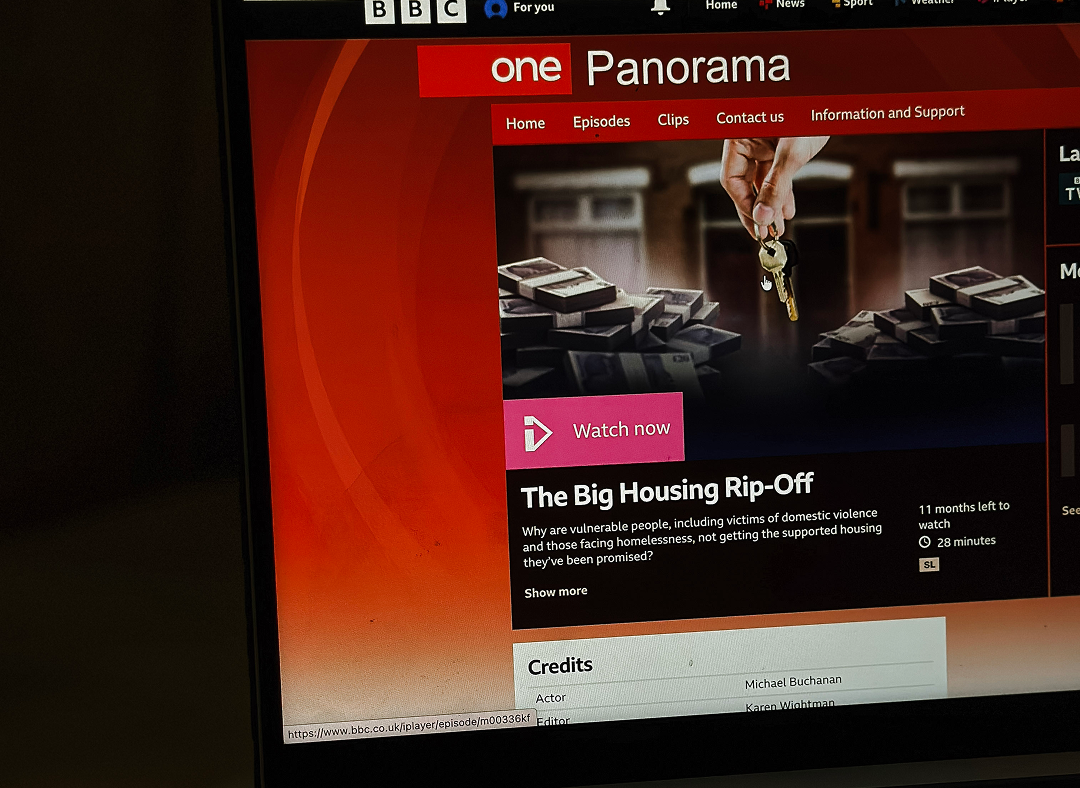
Our Response to BBC Panorama’s “The Big Housing Rip-Off”
Supported accommodation has been in the news recently, but for all the wrong reasons. Here's our response to the BBC Panorama and Times coverage, and an open conversation on the issues, how we do it properly at René House, and why good providers shouldn’t be lumped in with the worst.
We weren’t sure whether to speak on this, but after a lot of thought, we think it’s important that we do.
Supported accommodation was in the news last week, and not for good reasons. First came an article and a widely shared social post from The Times, followed by a BBC Panorama investigation, “The Big Housing Rip-Off”.
Both looked at operators in the sector who make money from housing benefit while the vulnerable people living in their properties receive little or no real support.
What the coverage found
Panorama focused on Birmingham, where £410m was paid out for supported exempt accommodation in a single year. More than 34,000 people live in this type of housing in the city. In London, which is more than seven times larger, the figure is around 22,000.
The programme reported residents left without the support they were told to expect. It also described complicated arrangements in which the benefit is paid to a registered provider, which then pays other companies to manage the properties and deliver support. The Times looked at how some landlords are making large profits from the same system, with very little involvement in the day-to-day running of the homes.
It’s right that there is a spotlight is on this. People should want to know where the money goes and whether the people living in these homes are being looked after. Operators who treat the system as a way to make money, while leaving residents without proper support, let down the people they house and everyone who works hard to do this properly.
Why the funding is different
Supported housing isn’t capped in the same way as standard housing benefit. That’s because it’s meant to pay for real support, not just a room.
Done properly, it’s hands-on, accountable and built around the person living there. Done badly, as the articles describe, it’s a landlord stepping back and letting the money come in. The difference shows in who is housed, what happens when someone struggles, the impact of the support given, and where the money goes.
How we do it at René House
René House is a CIC, so our profits go back into the work, not into anyone’s pocket.
We don’t hand properties over and step away. Our support workers and the staff we employ are involved with the people living in our houses every day with regular one-to-ones, support sessions, and activities.
Residents live in safe, well-maintained homes looked after by our own property team. They get support with life skills, budgeting, tenancy management and emotional wellbeing, and we help them connect with mental health, drug and alcohol, and employment services. The aim is always the same: a stable home that helps someone move forward, not just somewhere to be placed.
Our response to the negativity
We welcome stronger oversight and more open conversations about how to do this right.
Parliament passed a law in 2023 to strengthen regulation of the sector, including a licensing scheme and a “fit and proper person” test. More than three years on, it is still waiting to make a practical difference.
Good providers like us have nothing to hide, but painting the whole sector in a negative light harms the good providers, and the people who rely on them.
The answer is to tackle exploitation and strengthen regulation, not to lump everyone together.
Supported accommodation does matter
Supported accommodation is needed more than ever. We need good providers who care about their residents and give them the support to move on and out of homelessness. We need better understanding of why this sector exists, and of the gaps facing people experiencing homelessness. And we need to share more of the good work, not just the bad.
If you’d like to know how it works, beyond what the articles show, you’re welcome to speak to us.
You can message us or email info@renehousecic.com